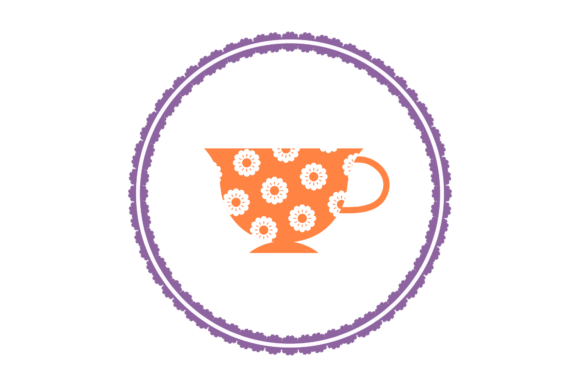
Floral Tea Cup: A Designer’s Real-World Embroidery Review
Let’s be honest—I opened Floral Tea Cup expecting charm, not complexity. As someone who’s stitched hundreds of icons for client totes, baby onesies, and boutique aprons, I know how quickly a pretty digital file can unravel under needle and thread. So when I loaded this design into my embroidery software and held it up against a linen tea towel sample, I wasn’t just checking resolution—I was asking: *Will this hold up on real fabric? Will my customers pause mid-unboxing and say, “Oh—this is special”?
First Impression: Delicate, Not Fussy
The Floral Tea Cup lands with quiet confidence. It’s not oversized or aggressively detailed—it’s balanced. The cup sits centered, with soft curving handles and a gentle floral sprig spilling from the rim. No tiny stems, no micro-petals that’ll vanish in satin stitch. The lines are clean but organic; the negative space breathes. This isn’t an icon built for vector purists alone—it’s drawn with stitch density in mind. You can feel where fill stitch will settle comfortably, where running stitch outlines will define without crowding, and where a single satin-stitched handle will catch light on a sweatshirt.
Where It Shines (and Where It Asks for Care)
I tested Floral Tea Cup across three real projects: a cotton tote for a local café, a bamboo-blend baby onesie, and a twill patch for a small-batch apron line. Here’s what stood out:
- Tote bags & tea towels: Perfect scale and contrast. On natural linen or unbleached cotton, the design reads clearly at 3.5"–4" wide—no blurring, no thread piling. The open cup shape avoids dense fill areas that trap lint or distort on repeated washing.
- Baby items & nursery decor: Gentle enough for delicate fabrics, but substantial enough to read at arm’s length. I avoided tight corners (like shoulder seams) and used lightweight cutaway stabilizer—no puckering, even on thin bamboo blends.
- Patches & caps: This is where caution kicks in. The cup’s curves work beautifully on flat patches—but on curved cap fronts, I resized down to 2.75" and added a slight stitch compensation. Without that tweak, the lower curve compressed and lost definition.
It’s not ideal for ultra-fine details on stretchy knits (think t-shirt side seams) or high-contrast dark-on-dark applications without careful thread selection. And while the PNG and JPG files make great printable mockups for Etsy listings, remember: those aren’t embroidery files. You’ll need to digitize—or confirm your machine embroidery software reads the AI/EPS/SVG cleanly before stitching.
What It Adds to Your Finished Product
There’s a subtle lift in perceived value when Floral Tea Cup appears on a handmade item. It doesn’t scream “handmade”—it whispers “thoughtfully made.” That matters for Etsy sellers pricing personalized gifts or craft fair shoppers comparing $38 vs. $48 kitchen towels. Customers recognize intention: the cup isn’t generic; the florals aren’t clipart. It reads as curated—not copied.
For small shop owners building brand consistency, this icon works as a quiet signature. Stitch it subtly on the hem of a pillow cover, or scaled larger on a boutique apron pocket—it supports tone without dominating. And because it’s rooted in warmth (tea, florals, comfort), it fits seamlessly into holiday embroidery, wedding favors, or new-parent gift sets—no rebranding needed.
Designer Notes You’ll Actually Use
Before you load Floral Tea Cup into your hoop, here’s what I do—and recommend:
- Test on scrap fabric first, especially if using textured weaves (like burlap or heavy terry) or dark backgrounds. Thread color contrast changes everything—try ecru on navy, or charcoal on cream.
- Review stitch density in your embroidery software. If the original file includes layered fills, check whether the cup base and floral elements share similar density. Uneven density causes shifting on lightweight fabrics.
- Confirm hoop size compatibility. At full 1920px × 1280px canvas size, this isn’t a 4" hoop design out of the box—you’ll likely resize. Don’t assume scaling preserves stitch integrity; always re-check jump stitches and trim points after resizing.
- Inspect small details at actual stitch size. Zoom in on the handle join and petal tips. If they’re under 1mm in final output, consider simplifying or reinforcing with a running stitch outline.
- Mock it in black and white. This reveals visual weight imbalances faster than color ever will—especially important for commercial embroidery where consistency across batches matters.
- Use appropriate stabilizer. Lightweight cutaway for knits, tear-away for stable wovens, and fusible + tear-away for patches. Skip basic tear-away on thin baby fabrics—it won’t support the cup’s gentle curves.
- Verify licensing before selling finished items. Since this is listed as an Icons / Graphics product with AI/EPS/SVG/JPG/PNG files, confirm whether commercial use—including embroidered products sold on Etsy or in your small shop—is explicitly permitted.
A Quiet Icon With Real Utility
Floral Tea Cup won’t dominate your portfolio—but it’ll earn repeat orders. It’s the kind of design that makes a custom embroidered sweatshirt feel like a gift, not just apparel. It gives a handmade tea towel personality without clutter. It helps a craft business stand out not through flash, but through cohesion and care.
If you’re choosing between dozens of floral icons for your next batch of patches, baby onesies, or holiday embroidery kits—pause here. This one balances simplicity and soul. It’s easy to edit, yes—but more importantly, it’s easy to trust.